Discover how AI agents are taking over in 2026. Learn the difference between standard AI tools and autonomous AI agents, and how they are transforming daily productivity.
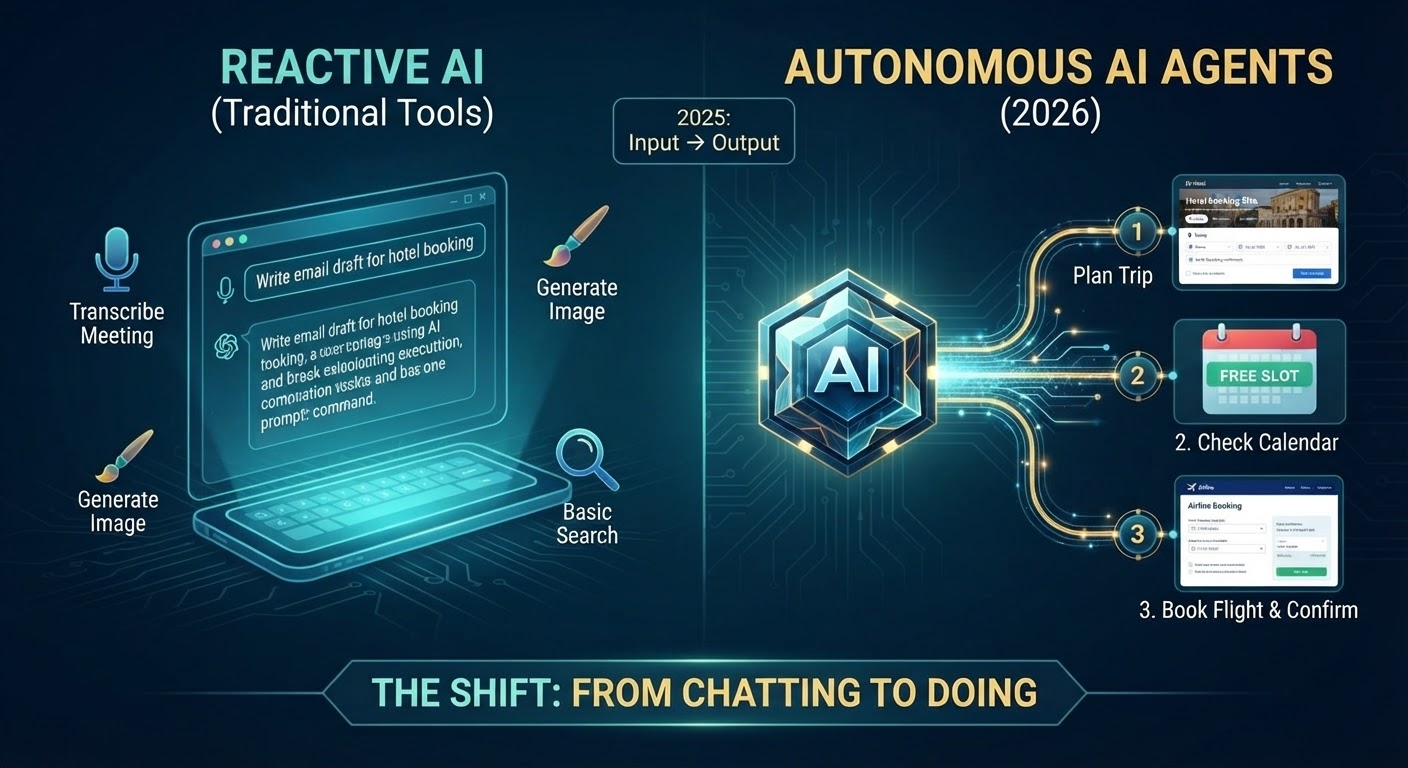
For the past few years, artificial intelligence has been the biggest buzzword in technology. We have all used popular AI chatbots to draft emails, generate creative ideas, or get quick answers to complex questions. However, as we move through 2026, a massive shift is occurring. We are transitioning from “reactive AI” that only responds to our prompts, to “autonomous AI agents” that can actively perform tasks on our behalf.
If you want to stay ahead of the technology curve, understanding this evolution is crucial. In this article, we will break down what AI agents are, how they differ from traditional AI tools, and how they are quietly reshaping our daily lives.
What Exactly is an AI Agent?
Unlike a standard AI assistant that waits for you to type a question and then gives you a text response, an AI Agent is designed to reason, plan, and take action autonomously.
Think of it this way: instead of asking an AI to “write an email to a hotel booking customer support,” you can tell an AI Agent to “find a hotel in Rome under $150 with a gym, book the room for next weekend, and confirm it with my calendar.” The AI agent will navigate the web, compare prices, make decisions, and complete the actual booking process without you needing to click a single link.
How AI Agents are Transforming Daily Productivity
The practical applications of autonomous agents are expanding rapidly across various sectors, making everyday digital workflows incredibly seamless. Here is how they are making an impact:
1. Hyper-Personalized Planning
Planning trips, managing personal finances, or scheduling meetings used to take hours of switching between different browser tabs. AI agents can now connect directly to your digital calendar, emails, and preference files. They can coordinate meetings with multiple people autonomously, shifting schedules dynamically when conflicts arise, and sending final invites to everyone involved.
2. Advanced Research and Summarization
Instead of manually searching Google and reading through dozens of articles, you can task an agent with gathering comprehensive research. An AI agent can read multiple web pages, cross-reference statistics, verify facts, and compile a clean, highly structured report with citations—all within a couple of minutes.
3. Seamless Smart Home Automation
Smart home devices are becoming genuinely smart. Instead of manually setting routines, AI agents analyze your daily habits—like when you wake up, what temperature you prefer during different seasons, and when you leave for work—and automatically optimize your home’s energy usage, lighting, and security without requiring constant input.
Why AI Agents are the Future of Software
Traditional software applications require human input for every step of a process. AI agents are breaking these boundaries by introducing inference and action. They learn from historical data, adapt to your specific preferences over time, and execute multi-step workflows across different platforms.
This technology is making complex digital tasks accessible to everyone, reducing the time spent on repetitive administrative chores and allowing us to focus on creative and high-value work.
Conclusion
The era of simply chatting with AI is evolving into a reality where AI works directly for us. As autonomous AI agents become more integrated into our smartphones, browsers, and daily tools, they are set to become the ultimate companion for personal and professional productivity.
What are your thoughts on letting AI agents handle your daily digital tasks? Let us know in the comments section below!