For the last few years, the world has been obsessed with “chatting” with AI. We’ve used powerful AI models to draft emails, summarize articles, and generate creative ideas. These tools are impressive, but they are essentially reactive: they wait for a prompt, and then they respond.
As we move through 2026, a massive technological shift is occurring. We are transitioning from “Reactive AI” (tools) to “Autonomous AI Agents” (digital peers).
What Exactly is an AI Agent?
Unlike a standard AI assistant that waits for you to type a question, an AI Agent is designed to reason, plan, and take action autonomously.
Think of it this way: instead of asking an AI to “write an email to a hotel booking customer support,” you can tell an AI Agent to “find a hotel in Rome under $150 with a gym, book the room for next weekend, and confirm it with my calendar.” The agent will navigate the web, compare prices, and complete the booking process without you needing to click a single link.
How AI Agents Are Transforming Productivity
The practical applications of autonomous agents are expanding rapidly, making digital workflows seamless.
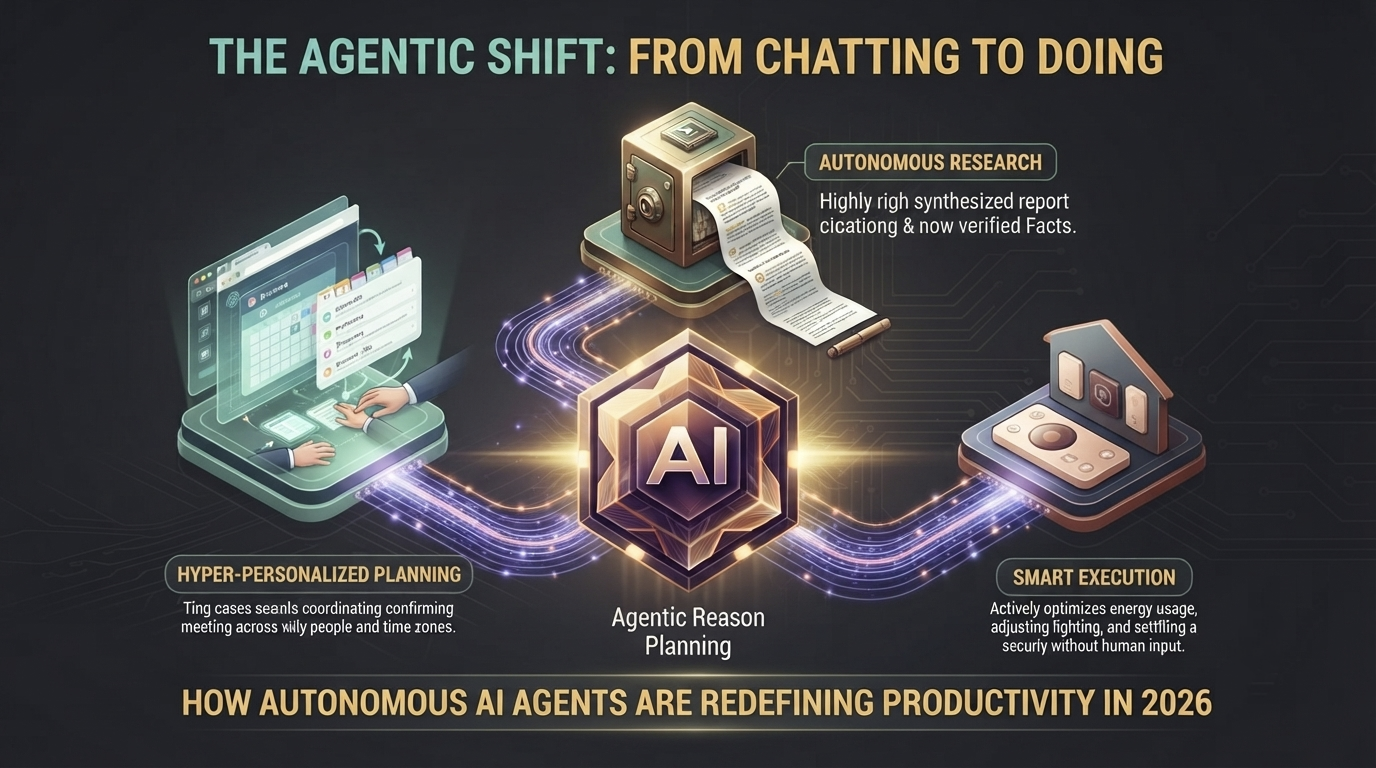
- Hyper-Personalized Planning: Agents connect directly to your calendar and emails to coordinate meetings with multiple people, shifting schedules dynamically when conflicts arise.
- Advanced Research: Instead of manually searching Google, you can task an agent with gathering research. It can read multiple web pages, cross-reference statistics, and compile a structured report with citations in minutes.
- Smart Home Automation: Agents analyze your daily habits—such as your wake-up time and temperature preferences—to automatically optimize energy usage, lighting, and security.
Why AI Agents Are the Future of Software
Traditional software requires human input for every step. AI agents break these boundaries by introducing inference and action. They learn from historical data, adapt to your specific preferences over time, and execute multi-step workflows across different platforms.
This technology is making complex digital tasks accessible to everyone, reducing the time spent on repetitive administrative chores and allowing us to focus on creative and high-value work.
Conclusion
The era of simply chatting with AI is evolving into a reality where AI works directly for us. As autonomous AI agents become more integrated into our smartphones, browsers, and daily tools, they are set to become the ultimate companion for personal and professional productivity.
What are your thoughts on letting AI agents handle your daily digital tasks? Do you trust them to manage your personal schedule or travel plans? Let us know in the comments section below!


